ATM dispute guide
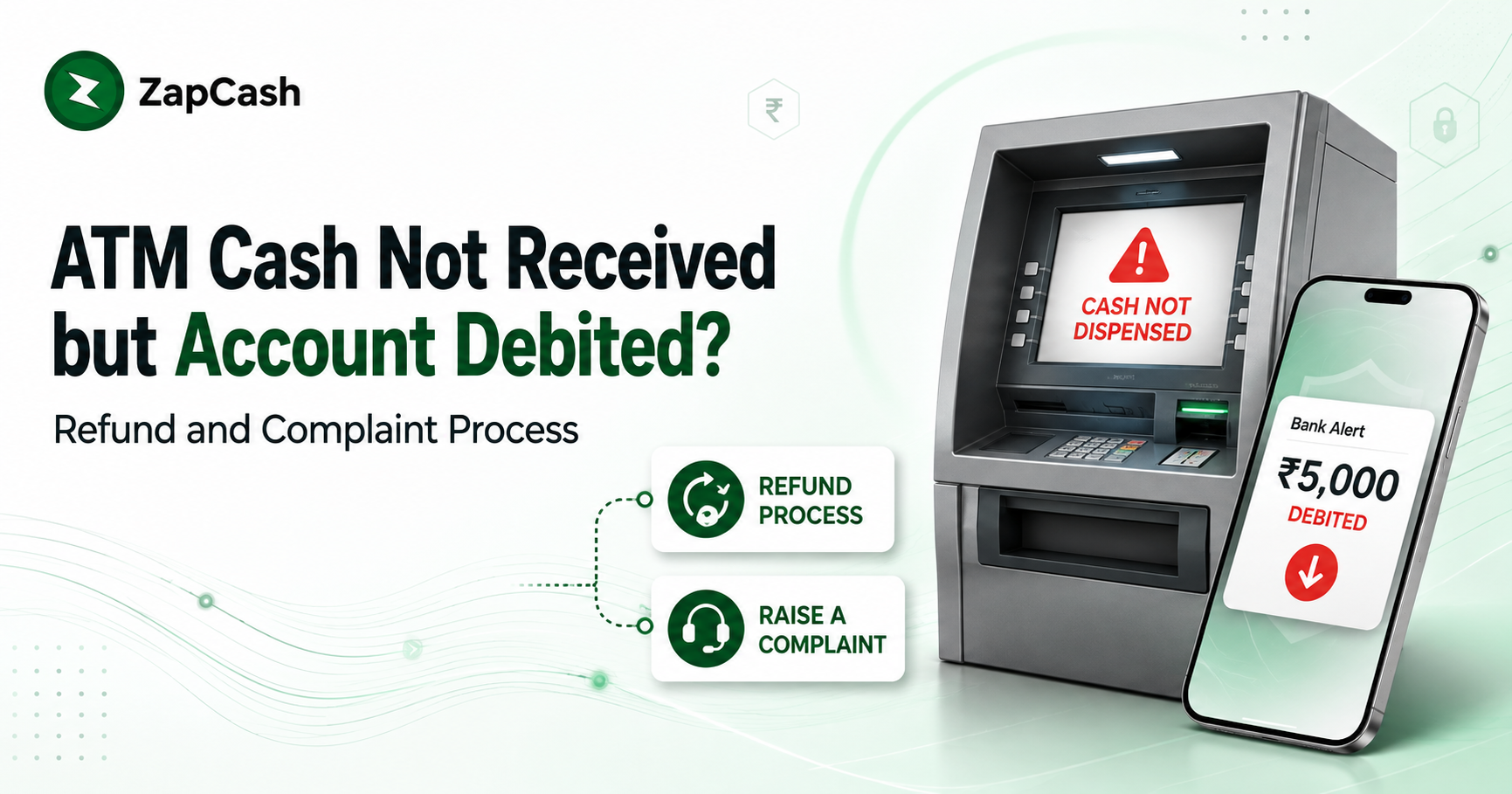
ATM Cash Not Received but Account Debited? Refund and Complaint Process
You enter the amount, type your PIN and wait for the ATM to dispense the cash.
Refund deadline
T+5
calendar days
Delay compensation
₹100
per day beyond T+5
Who to contact
Card-issuing bank
even if the ATM belongs to another bank
Instead, the screen displays an error—or simply returns your card. No cash comes out, but your phone immediately receives a debit message.
It is worrying, but the money is not usually lost.
Under the Reserve Bank of India’s failed-transaction framework, when an ATM debits your account but does not dispense cash, the bank must proactively reverse the failed transaction within a maximum of T+5 calendar days. Here, T is the calendar date of the transaction.
If the reversal is delayed beyond T+5, the bank must credit ₹100 per day of delay as compensation. RBI says this compensation should be paid automatically without waiting for a separate claim.
You should still report the failed withdrawal promptly, save the complaint number and monitor your account until both the refund and any applicable compensation arrive.
Information last verified: 25 August 2026
Bank complaint processes can change. Verify contact details through your bank’s official website or mobile application before sharing any information.
Key takeaways
- Refund deadline: Maximum T+5 calendar days for an eligible failed ATM withdrawal.
- Meaning of T: The calendar date on which the transaction happened.
- Delayed-refund compensation: ₹100 for every day of delay beyond T+5.
- Who to contact: The bank that issued your debit card—even if you used another bank’s ATM.
- What to save: Debit message, transaction reference, ATM ID, location, date, time, amount and complaint number.
- Where to escalate: Your bank’s grievance or nodal officer, followed by the RBI Complaint Management System when eligible.
ATM cash not received but amount deducted: Quick answer
| Situation | What you should do |
|---|---|
| No cash came out, but the account was debited | Save the details and complain to your card-issuing bank |
| You used another bank’s ATM | Still complain to the bank that issued your card |
| Refund has not arrived | Track it against the T+5 calendar-day deadline |
| Refund arrived after T+5 | Check for ₹100-per-day compensation |
| Bank has not replied for 30 days | Consider filing through RBI CMS |
| Withdrawal was not made by you | Block the card and report it immediately as an unauthorised transaction |
Do not share your ATM PIN, OTP or CVV to obtain a refund. A genuine reversal does not require you to reveal these details or transfer money.
What does RBI say about failed ATM withdrawals?
RBI circular RBI/2019-20/67, DPSS.CO.PD No.629/02.01.014/2019-20, dated 20 September 2019, sets an outer limit for reversing failed transactions through authorised payment systems.
For an ATM or micro-ATM transaction in which the customer’s account is debited but cash is not dispensed, the circular specifies:
- Proactive reversal within a maximum of T+5 days
- Compensation of ₹100 per day for delay beyond T+5
- Automatic payment of the applicable compensation without waiting for a complaint or claim
RBI also explains that T refers to the calendar date, not a working day. Weekends and public holidays are therefore not excluded while counting the five days.
You can verify these rules in RBI’s official failed-transaction circular.
The prescribed timeline is the maximum allowed period. Your money may return within a few minutes, a few hours or sooner than five days.
The RBI framework quoted here covers domestic transactions. If the withdrawal happened outside India, ask your card-issuing bank about the card network’s applicable dispute process and timeline.
What is a failed ATM transaction?
A failed transaction is one that was not fully completed for a reason not attributable to the customer.
For example:
- The ATM had no cash
- The machine timed out
- The communication link failed
- The ATM displayed an error
- The machine did not dispense the requested notes
Think of an ATM like a vending machine connected to your bank account. The bank may receive the “payment accepted” message even though the machine fails to deliver the product. The bank and ATM operator then compare their electronic records and the cash remaining inside the machine to identify the failed delivery.
How does the T+5 ATM refund timeline work?
Suppose you try to withdraw ₹10,000 on 10 August and no cash is dispensed.
- T: 10 August, the transaction date
- T+5 deadline: 15 August
- Refund credited: 19 August
- Delay beyond T+5: Four days
- Compensation: ₹100 × 4 = ₹400
In this example, the account holder should receive the original ₹10,000 and ₹400 as delayed-reversal compensation.
The compensation does not replace your refund. It is an additional amount for the delay.
What to do immediately when an ATM gives no cash
Step 1: Wait briefly and check the cash slot
Remain near the ATM for a short time and check whether the machine displays a final transaction message.
Do not leave your card in the machine, insert your hand or any object into the cash slot, or accept help from a stranger.
If the session has ended and no cash has appeared, move to the next step.
Step 2: Confirm whether your account was actually debited
Do not rely only on what appeared on the ATM screen.
Check:
- Your bank’s SMS or email alert
- Mobile banking transaction history
- Internet banking
- Account statement or mini statement
- Current account balance
If you are an SBI customer, our SBI balance-check guide explains the official missed-call, SMS, YONO and online methods.
Sometimes the debit is reversed almost immediately. Save proof even if the balance returns quickly.
Step 3: Record the ATM and transaction details
Save as much information as you safely can:
- Withdrawal amount
- Date and exact time
- ATM location
- ATM ID displayed on the machine
- Name of the bank or ATM operator
- Transaction reference or retrieval reference number, if available
- Last four digits of the debit card
- ATM receipt, if one was printed
- Screenshot or statement showing the debit
- Error message shown on the screen, if visible
You may photograph the ATM ID or location details, but do not photograph another customer, expose your full card number or create a security risk inside the kiosk.
Step 4: Do not keep repeating the withdrawal
First confirm the status of the failed attempt.
Repeated withdrawals can lead to additional debits and make it harder to track which transaction is being disputed. If you urgently need cash, consider another safe payment or withdrawal method only after checking your balance.
Step 5: Complain to the bank that issued your card
Contact the bank whose debit card you used. This is called the card-issuing bank.
Use an official channel such as:
- The bank’s mobile application
- Internet banking
- Customer-care number shown on the official bank website
- The bank’s ATM or debit-card dispute form
- Your bank branch
- The bank’s official grievance email or portal
RBI has specifically stated that when a failed transaction happens at another bank’s ATM, the customer should still complain to the card-issuing bank. Your bank will coordinate with the bank or company operating the ATM.
Step 6: Get and save the complaint number
Ask for a service-request, ticket or complaint reference number.
Save:
- The date you complained
- The complaint number
- Confirmation email or SMS
- Screenshots of the complaint
- Copies of any replies
- Name or designation of any bank representative contacted
Without an acknowledgement, proving when you raised the issue can become more difficult.
Step 7: Monitor the refund and compensation separately
Check your account until the original debit is reversed.
If it arrives after T+5, also look for a separate compensation credit. If the ₹100-per-day compensation is missing, write to the bank and mention the RBI circular, transaction date, reversal date and number of delayed days.
Which bank should you contact if you used another bank’s ATM?
Always begin with the bank that issued your debit card.
For example, imagine that you use an HDFC Bank debit card at an SBI ATM. Your HDFC Bank account is debited, but the SBI ATM does not dispense cash.
You should raise the complaint with HDFC Bank, because it issued the card and holds the debited account. HDFC Bank will coordinate with the ATM-owning bank through the relevant payment network.
You do not need to resolve the dispute yourself between the two banks.
The ATM operator’s details may still be useful, so record the ATM ID and location before leaving.
How to write an ATM refund complaint
You can use the following format when emailing the bank or submitting a written complaint:
Subject: Failed ATM withdrawal—account debited but cash not dispensed
I attempted to withdraw ₹[amount] on [date] at [time] from the ATM located at [location]. The ATM did not dispense cash, but my bank account was debited.
Card last four digits: [XXXX]
ATM ID: [ATM ID]
Transaction reference/RRN: [reference number]
ATM operator/bank: [name]
Account number: [masked account number]
Please investigate the failed transaction, reverse the debited amount and provide a complaint reference number. Please also credit any compensation applicable under RBI circular RBI/2019-20/67 if the reversal exceeds the prescribed T+5 timeline.
Attach only the necessary evidence. Never write your ATM PIN, CVV, OTP, internet-banking password or complete debit-card number in the complaint.
What happens after you raise the complaint?
Your bank may examine records such as:
- The electronic journal maintained by the ATM
- Transaction and payment-network logs
- Cash-dispensing records
- Cash remaining in the ATM during reconciliation
- Error codes recorded by the machine
- Available CCTV footage, when relevant
In simple terms, the bank checks whether the machine’s records and physical cash count match the debit made to your account.
You normally do not need to collect these technical records yourself during the initial complaint. Your role is to provide accurate transaction details and preserve every complaint acknowledgement.
What if the ATM dispensed only part of the amount?
Suppose you requested ₹10,000 and your account was debited by ₹10,000, but the ATM dispensed only ₹6,000.
Report it immediately as a partial cash dispense or cash discrepancy. Clearly state:
- Amount requested
- Amount debited
- Amount actually received
- Shortfall requiring reversal
Do not describe it simply as “no cash received,” because the investigation must account for the notes you did receive.
The RBI table specifically describes a case where the account is debited but cash is not dispensed. For a partial-dispense case, ask your card-issuing bank to confirm the applicable dispute category and timeline while seeking reversal of the shortfall.
What if the ATM shows “successful” but no cash was received?
Raise a complaint even if the ATM screen, bank message or statement describes the transaction as successful.
The status shown to you is not the only record available. The bank can examine the ATM journal, transaction logs and cash reconciliation.
When complaining:
- State clearly that no cash was received.
- Provide the exact date, time, amount, location and ATM ID.
- Ask for a written complaint acknowledgement.
- Request the reason in writing if the bank rejects the claim.
- Escalate through the bank’s grievance process if the explanation is not satisfactory.
Do not assume that a “successful” label means you have no right to dispute the withdrawal.
What if the cash appeared but was taken back by the ATM?
An ATM may retract notes when they are not collected within the available time.
If the machine took the cash back before you could collect it, report the incident to your card-issuing bank. Describe it as a cash-retraction dispute and include the exact time and ATM ID.
Do not try to pull notes from a closing shutter or interfere with the cash slot. The bank should investigate the machine records and reconciliation.
What if the refund does not arrive within T+5 days?
Use the escalation process in stages.
Level 1: Follow up with regular bank support
Contact the bank using your existing complaint number. Ask for:
- Current dispute status
- Expected reversal date
- Reason for the delay
- ₹100-per-day compensation applicable beyond T+5
Avoid opening multiple unrelated complaints for the same transaction unless the bank asks you to do so.
Level 2: Escalate to the bank’s grievance or nodal officer
Banks publish a grievance-redressal hierarchy on their official websites. If first-level support does not resolve the problem, write to the grievance officer or nodal officer.
Include:
- Original complaint number and date
- Transaction details
- Statement showing the debit
- Copies of earlier correspondence
- T+5 deadline
- Actual refund date, if the refund was late
- Compensation calculation
- The resolution you are requesting
Level 3: Use the NPCI complaint facility when applicable
NPCI provides an online facility to check eligible transactions and register complaints with member banks. Its form may request information such as the bank name, transaction date and 12-digit RRN.
You can access it through NPCI’s official complaint page. NPCI explains that the relevant member bank remains responsible for resolving the complaint.
Use this as an additional official record—not as a replacement for complaining to your bank.
Level 4: Approach the RBI Ombudsman when eligible
You must first complain to the bank.
You can generally approach the RBI Ombudsman if:
- The bank does not reply within 30 days after receiving your complaint
- The bank rejects the complaint wholly or partly
- You receive a response but are not satisfied with the resolution
File through the official RBI Complaint Management System. Complaints under the Reserve Bank–Integrated Ombudsman Scheme, 2026, which replaced the 2021 scheme from 1 July 2026, are cost-free. You can verify the current eligibility and filing rules in RBI’s official RB-IOS 2026 FAQs.
Upload your bank complaint, transaction evidence, bank response and a clear explanation of the resolution you want.
If the bank has not yet replied and 30 days have not passed, an RBI Ombudsman complaint may be treated as premature.
Can you claim ₹100 per day if the bank refunds late?
Yes, when the failed ATM transaction falls under the RBI framework and the reversal is completed after the maximum T+5 period.
RBI says the compensation should be credited suo motu. In simple language, that means automatically—you should not have to request it separately.
If the refund arrives but the compensation does not:
- Calculate the number of days beyond T+5.
- Multiply those delayed days by ₹100.
- Write to the bank using your original complaint number.
- Cite RBI circular RBI/2019-20/67.
- Ask for the compensation calculation and credit in writing.
- Escalate through the bank and RBI Ombudsman channels when eligible.
Do not calculate compensation from the transaction date itself. It applies only to the days of delay after T+5.
What if you did not make the ATM withdrawal?
An unauthorised ATM withdrawal is different from a failed transaction.
If money was withdrawn using your card or account without your permission:
- Block the debit card immediately through an official bank channel
- Report the transaction to your bank without delay
- Change relevant banking credentials
- Preserve the debit alert and statement
- Ask for a fraud or unauthorised-transaction complaint number
- Follow the bank’s fraud-reporting and grievance procedure
Do not wait for the failed-ATM T+5 process when you suspect fraud. Immediate reporting matters in an unauthorised transaction.
ATM refund fraud: Important safety precautions
Fraudsters often take advantage of customers who are already anxious about missing money.
Protect yourself:
- Call only numbers listed on your bank’s official website or app.
- Do not trust a phone number pasted on an ATM without verifying it.
- Never tell anyone your ATM PIN.
- Never share an OTP, CVV or internet-banking password.
- Do not install a screen-sharing application for “refund assistance.”
- Do not scan a QR code to receive an ATM refund.
- Do not approve a UPI collect request for a refund.
- Do not make a small “verification payment.”
- Do not hand your card to a stranger offering help.
- Do not post unmasked bank statements or card details on social media.
A genuine ATM refund is credited back through the banking system. You do not need to enter a PIN or send money to receive it.
Failed ATM transaction checklist
- ☐ I confirmed that my account was debited
- ☐ I recorded the date, time, amount and ATM location
- ☐ I saved the ATM ID and transaction reference, if available
- ☐ I kept the receipt, debit message or statement
- ☐ I complained to the bank that issued my card
- ☐ I saved the complaint reference number
- ☐ I calculated the T+5 calendar-day deadline
- ☐ I checked whether the refund arrived
- ☐ I checked for ₹100-per-day compensation if the refund was late
- ☐ I escalated through official channels when necessary
Final takeaway
If an ATM does not dispense cash but your account is debited, stay calm and preserve the transaction details.
Complain to the bank that issued your debit card, even if you used another bank’s ATM. Save the complaint number and monitor your account.
Under RBI’s failed-transaction framework:
- The reversal must be completed within a maximum of T+5 calendar days.
- A delay beyond T+5 attracts ₹100 per day in compensation.
- The applicable compensation should be credited automatically.
If the bank does not resolve the issue, escalate through its grievance officer and then use RBI CMS when eligible.
Most importantly, never share your PIN, OTP or CVV with anyone offering to arrange the refund. A genuine reversal does not require a payment, QR-code scan or remote access to your phone.
ATM cash-not-received FAQs
How long does an ATM refund take?
Under RBI’s framework, when an ATM debits the customer’s account but does not dispense cash, the failed transaction must be proactively reversed within a maximum of T+5 calendar days. The money may return sooner.
Does T+5 mean working days or calendar days?
Calendar days. RBI defines T as the day of the transaction and says it refers to the calendar date. Weekends and public holidays are included.
Should I wait five days before complaining to the bank?
No. The reversal is supposed to be proactive, but reporting the failed withdrawal promptly creates a formal record and makes follow-up easier. Save the complaint number.
Whom should I contact if I used another bank’s ATM?
Contact the bank that issued your debit card. For example, if you used an SBI card at an ICICI Bank ATM, begin with SBI.
What if the ATM did not print a receipt?
You can still complain. Provide the date, time, amount, ATM ID or location, the card’s last four digits and the debit shown in your account. Save the bank’s complaint number.
Where can I find the ATM transaction reference number?
It may appear on the ATM receipt, bank SMS, transaction details in mobile banking or your account statement. If you cannot find it, provide the bank with the other details so it can identify the withdrawal.
Is ₹100-per-day compensation automatic?
RBI states that applicable compensation should be credited automatically without waiting for a complaint or claim. If it is missing, ask your bank to credit it and cite the applicable RBI circular.
Can I complain directly to the RBI immediately?
You must first complain to your bank. If the bank gives an unsatisfactory response or rejects the complaint, you may approach the RBI Ombudsman. When the bank gives no response, you generally need to wait 30 days before filing through the RBI Complaint Management System.
Can I receive a refund if the ATM transaction shows successful?
You can still raise a dispute when no cash was received. The bank can investigate the ATM’s electronic records and cash reconciliation rather than relying only on the customer-facing status.
Does an ATM refund require an OTP or ATM PIN?
No. Never share your OTP, ATM PIN or CVV for a refund. Do not scan a QR code or transfer money to receive a reversal.
What if I received less cash than the amount debited?
Report it as a partial-dispense or cash-discrepancy complaint. Tell the bank the amount requested, the amount debited, the cash actually received and the exact shortfall.
Does disputing a failed ATM withdrawal affect my credit score?
No. An ATM dispute does not itself affect your credit score. However, if you intended to use the cash for an EMI or bill, make alternative arrangements so the separate payment does not become overdue.
Is an ATM refund the same as a UPI refund?
No. ATM and UPI failures follow different transaction processes, and the applicable timeline depends on the payment type. If your problem involved a UPI transfer or merchant payment, read our UPI payment failed but money debited guide.