An instant personal loan can help when you need quick access to funds and do not want to visit a branch, submit physical paperwork, or wait several days for a decision. But “instant” does not mean automatic approval. Lenders still check your KYC, credit profile, income, bank account, existing obligations, and internal policy before approving and disbursing the loan.
This guide explains how an instant personal loan works in India, what happens during approval, how personal loan KYC is completed, when loan disbursal happens, what EMI repayment means, and which charges you should check before accepting the offer.
What is an instant personal loan?
An instant personal loan is an unsecured loan that you can apply for online through a bank, NBFC, or digital lending app. Since it is unsecured, you do not need to pledge collateral such as gold, property, or fixed deposits.
The process is usually faster than a traditional personal loan because the application, document collection, KYC, agreement, and approval checks are handled digitally. If your profile meets the lender’s criteria, you may receive a loan offer online and accept it through e-sign or digital consent.
Key features usually include:
- No collateral required
- Online personal loan application
- Digital KYC and document verification
- Loan amount based on eligibility
- EMI-based repayment
- Fixed tenure chosen at the time of approval
- Interest and charges disclosed before acceptance
Approval is not guaranteed. The lender may reject the application if your income, credit history, KYC, bank account activity, or existing EMIs do not match its policy.
How does an instant personal loan work?
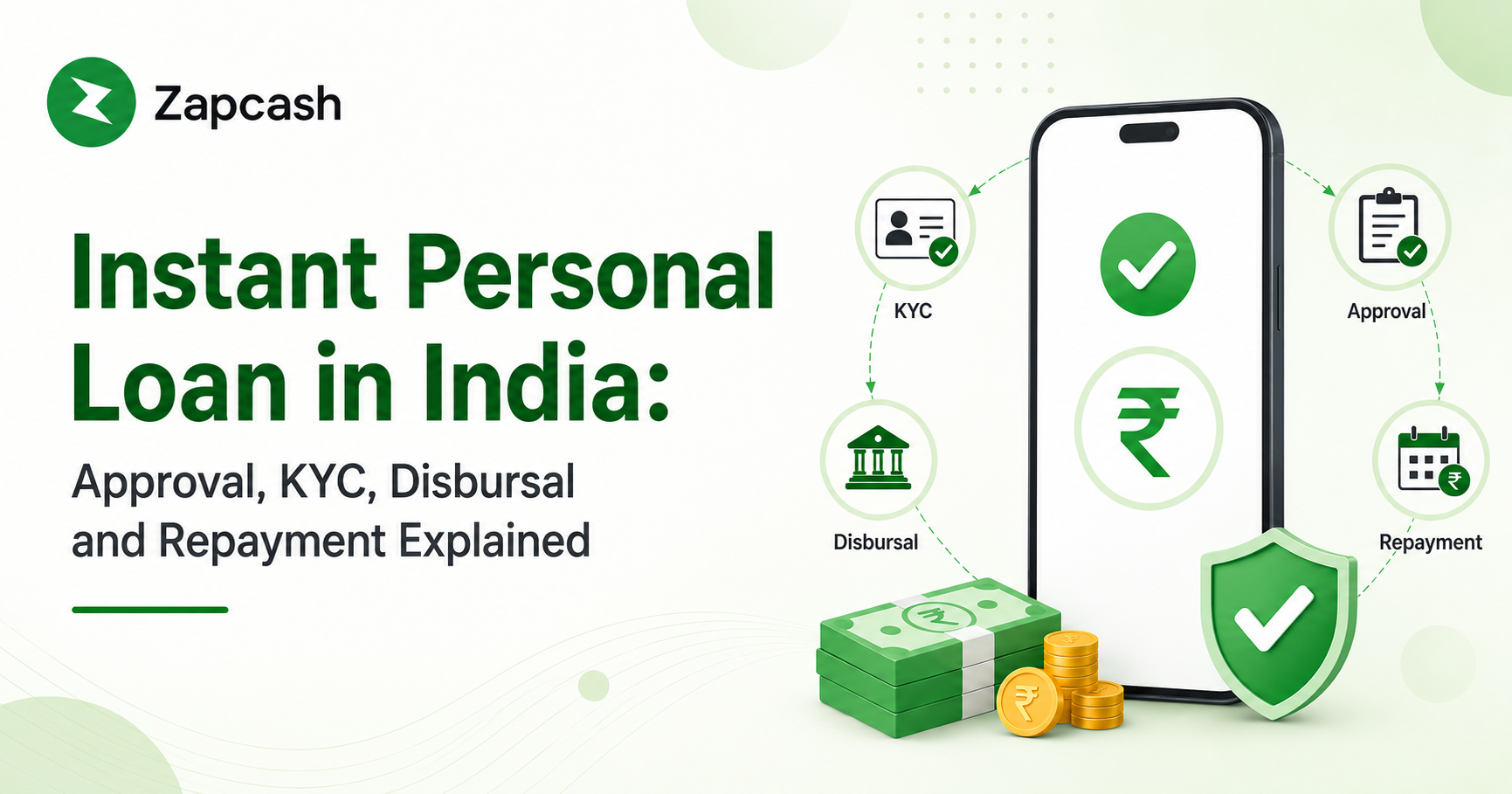
Here is the typical journey from application to repayment:
| Step | What happens | What the borrower should check |
|---|---|---|
| 1. Application | You enter basic details such as name, mobile number, PAN, income, employment type, and loan amount | Make sure all details match your official documents |
| 2. Eligibility check | The lender checks whether you meet basic personal loan eligibility criteria | Age, income, city, employment type, and loan amount matter |
| 3. KYC verification | Identity, address, PAN, Aadhaar OTP, selfie, or other checks may be completed | Use your own active mobile number and valid documents |
| 4. Credit and income assessment | The lender reviews credit history, income, bank activity, and repayment capacity | Existing EMIs and overdue loans can affect approval |
| 5. Loan offer | If eligible, you receive an offer with amount, interest, tenure, EMI, and charges | Compare EMI, APR, fees, and total repayment amount |
| 6. Agreement or e-sign | You accept the loan terms digitally | Read the loan agreement and Key Fact Statement carefully |
| 7. Disbursal | Approved funds are transferred to the verified bank account | Bank details must be correct and active |
| 8. EMI repayment | EMI is collected monthly through auto-debit, NACH, UPI mandate, or another approved method | Keep balance ready before the due date |
The whole process may feel quick, but every step has a purpose. A lender cannot responsibly disburse money without checking identity, repayment ability, and account validity.
Instant personal loan approval process
Instant loan approval usually means quick decisioning after digital checks. It does not mean every applicant will be approved.
When you apply, lenders usually check:
- PAN and identity details
- Credit score and repayment history
- Monthly income
- Existing EMIs and current debt burden
- Employment or business stability
- Bank statement or account activity
- Previous defaults, write-offs, or overdue loans
- Contact and address verification
- Internal lender policy
For example, two borrowers may both earn ₹40,000 per month. One has no existing EMI and a clean repayment record. The other already pays ₹22,000 in EMIs and has a recent overdue credit card bill. The second borrower may receive a lower offer or face rejection, even with the same income.
Lenders are mainly trying to answer one question: can this borrower repay the EMI on time without becoming overburdened?
KYC process for instant personal loans
Personal loan KYC confirms your identity, address, and bank account details. It is a mandatory part of regulated lending in India.
Depending on the lender and process, KYC may include:
- Aadhaar-based verification or OTP verification
- PAN validation
- Selfie or liveness check
- Address verification
- Bank account verification
- Digital agreement or e-sign
- EMI mandate setup through NACH, UPI, or net banking
Keep these documents and details ready before applying:
| Document or detail | Why it may be needed |
|---|---|
| PAN | Identity verification and credit bureau checks |
| Aadhaar-linked mobile number | OTP-based identity verification |
| Bank account details | Disbursal and repayment setup |
| Salary slips or income proof, if required | Income assessment |
| Bank statement, if required | Cash flow and repayment capacity check |
| Active mobile number and email | Communication, OTPs, and loan documents |
Never share OTPs, passwords, or banking PINs with anyone claiming to help with approval. Complete KYC only through the official lender app, website, or verified process.
Loan disbursal: when do you receive the money?
Approval and disbursal are not the same.
Approval means the lender has agreed to offer a loan, subject to final checks and your acceptance of terms. Loan disbursal means the money has actually been transferred to your bank account.
Disbursal usually happens after:
- KYC is completed
- Loan agreement is accepted
- Bank account is verified
- EMI mandate or NACH setup is completed
- Final lender approval is done
- No additional risk or verification issue is found
The timing varies by lender, bank processing, applicant profile, working hours, and verification status. Some approved applications may be disbursed quickly, while others may take longer if documents, bank details, mandate setup, or internal checks need review.
Before accepting the loan, check whether the bank account is active, belongs to you, and can receive credits. Incorrect account numbers, wrong IFSC codes, frozen accounts, or name mismatches can delay disbursal.
Repayment: EMI, tenure and auto-debit
EMI stands for Equated Monthly Instalment. It is the fixed amount you repay every month during the loan tenure. Each EMI usually includes both principal and interest.
For an instant personal loan, repayment terms are generally decided before disbursal. You should check:
- EMI amount
- Tenure in months
- Due date
- Auto-debit or NACH setup
- Late payment charges
- Bounce charges
- Prepayment or foreclosure rules
- Credit score impact if EMI is missed
Here is a simple example, only for explanation:
Suppose you borrow ₹50,000 for 12 months at a fixed annual interest rate. Your EMI may be around a few thousand rupees per month, depending on the exact rate and charges. If you choose a longer tenure, the EMI may reduce, but the total interest paid can increase. If you choose a shorter tenure, the EMI will be higher, but the loan may close faster.
The better choice is not always the lowest EMI. Choose an EMI that fits your monthly cash flow without pushing you toward another loan.
Tip: Keep the EMI due date close to your salary or income date, with enough balance in the account before auto-debit.
Charges to check before accepting an instant personal loan
Do not accept a loan only by looking at the EMI. Check the total repayment amount and APR.
Here are the main personal loan charges to review:
| Charge | What it means | What to check |
|---|---|---|
| Interest rate | Cost charged on the borrowed amount | Fixed or reducing balance, annual rate |
| APR | Annual percentage rate including interest and certain charges | Better for comparing total cost |
| Processing fee | Fee charged for processing the loan | Amount, percentage, GST impact |
| GST | Tax applied on certain fees | Usually applies to processing and service charges |
| Late payment charges | Charged when EMI is not paid on time | Amount per delay or percentage basis |
| Bounce charges | Charged if auto-debit fails due to low balance or account issue | Applies even if payment is later completed |
| Penal charges | Additional charges for default or breach of terms | Read the agreement carefully |
| Foreclosure or prepayment charges | Charges for closing early or paying extra | Some lenders allow it after a minimum period |
| Documentation or platform charges | Any extra service or platform fee | Check if applicable before acceptance |
The Key Fact Statement or loan summary should clearly show the loan amount, interest rate, APR, tenure, EMI, fees, and repayment schedule. If these are unclear, pause before accepting.
Why instant personal loan applications get rejected
Personal loan rejection can happen even when the application is submitted correctly. Common reasons include:
- Low credit score
- High existing EMIs
- Incorrect PAN or Aadhaar details
- Incomplete KYC
- Unstable income
- Too many recent loan applications
- Existing overdue loans
- Bank statement mismatch
- Bank account verification failure
- Employment details not verifiable
- Lender policy mismatch
For example, if your income is ₹30,000 per month but existing EMIs already take ₹18,000, the lender may decide that adding another EMI is risky. If your PAN name and bank account name do not match, the application may need manual review or may fail verification.
Rejection does not always mean you can never get a loan. It means the current application did not meet the lender’s criteria.
How to improve your chances of approval
You cannot force approval, but you can reduce avoidable mistakes.
Practical steps:
- Apply for an amount you can realistically repay
- Keep PAN, Aadhaar, mobile number, and bank details accurate
- Maintain sufficient balance for mandate setup and EMI debit
- Avoid multiple loan applications at the same time
- Repay existing EMIs and credit card bills on time
- Check your credit report for errors
- Choose a realistic tenure
- Do not exaggerate income
- Use an active bank account with regular transactions
- Complete KYC only through official channels
A smaller loan amount with a comfortable EMI is often better than a larger loan that strains your budget. Lenders prefer borrowers who show repayment discipline.
Safety checklist before applying for an instant personal loan
Digital lending is convenient, but borrowers should be careful. Before applying through any digital lending app, check:
- Lender or NBFC name
- Whether the lending partner is clearly disclosed
- Key Fact Statement or loan summary
- APR, not just interest rate
- Processing fee, GST, and late charges
- Grievance redressal details
- Privacy policy and app permissions
- Official website or verified app listing
- Repayment terms and due date
- Whether upfront payment is demanded before approval
Avoid apps or agents that ask for advance fees to “unlock” approval. Be cautious with suspicious loan links from SMS, WhatsApp, or social media. Do not install unknown APK files outside official app stores. Also check app permissions — a loan app should not need unnecessary access that has no connection to loan processing.
Instant personal loan vs regular personal loan
| Factor | Instant personal loan | Regular personal loan |
|---|---|---|
| Application process | Mostly online through app or website | Online or branch-based |
| Approval time | Faster digital decisioning, subject to checks | May take longer due to manual review |
| Documentation | Digital KYC and uploaded documents | Physical or digital documents |
| Loan amount | Often based on quick eligibility and lender policy | May allow higher amounts depending on bank relationship |
| Interest rate | Depends on credit profile, lender, risk, and tenure | Depends on bank/NBFC policy and borrower profile |
| Best use case | Urgent short-term or medium-term need | Planned larger expenses |
| Verification process | Automated checks, KYC, bank validation, e-sign | Manual plus digital verification |
An instant personal loan is useful when speed and convenience matter. A regular personal loan may be better when you need a larger amount, want to compare more offers, or already have a strong relationship with your bank.
When should you take an instant personal loan?
Take an instant personal loan only when the need is genuine and repayment is manageable.
Good use cases include:
- Medical emergency
- Urgent travel
- Education expense
- Essential home repair
- Short-term cash flow need
- Debt consolidation, only if the new loan cost is lower
Avoid using it for:
- Unnecessary shopping
- Paying one loan with another without a repayment plan
- High-risk investment or trading
- Lifestyle expenses you can postpone
- Any expense where the EMI is unaffordable
Debt consolidation deserves special care. If you replace a high-cost loan or credit card balance with a lower-cost personal loan, it may help. But if you continue spending and take fresh debt again, consolidation becomes only a temporary fix.
Quick test: will this loan improve my situation after 3 to 6 months, or will it make my monthly budget tighter? If it makes the budget weaker, reduce the amount or wait.
Final thoughts
An instant personal loan can be useful when you need a quick, digital borrowing option in India. But speed should not replace caution.
Before applying, check your personal loan eligibility, keep documents ready, complete KYC carefully, review charges, compare APR, understand the EMI repayment schedule, and confirm the lender’s details. Approval depends on your profile and the lender’s checks, not just on submitting an online form.
The best loan is not the one with the fastest screen response. It is the one you can repay on time without disturbing your essential monthly expenses.
FAQs
What is an instant personal loan?
An instant personal loan is an unsecured loan that you can apply for online through a bank, NBFC, or digital lending app. The process is usually faster than traditional loans because application, KYC, approval checks, agreement, and disbursal are handled digitally.
Is instant personal loan approval guaranteed?
No. Instant personal loan approval is not guaranteed. Approval depends on eligibility, credit score, income, KYC verification, bank account checks, existing EMIs, lender policy, and final assessment.
Can I get an instant personal loan without documents?
You may not need to submit physical documents, but digital verification is still required. Lenders usually need PAN, Aadhaar-based verification, bank account details, and sometimes income proof or bank statements.
Is Aadhaar enough for an instant personal loan?
Aadhaar may help with identity or OTP verification, but it is usually not enough by itself. Lenders may also check PAN, credit history, bank account details, income, employment, and repayment capacity.
How long does loan disbursal take?
Disbursal time varies by lender, bank processing, applicant profile, KYC completion, agreement acceptance, and mandate setup. Approval and disbursal are separate steps.
Why was my instant personal loan rejected?
Common reasons include low credit score, high existing EMIs, incomplete KYC, incorrect PAN or Aadhaar details, unstable income, overdue loans, too many recent applications, or mismatch with lender policy.
Does applying for an instant personal loan affect my credit score?
It can. If the lender performs a hard enquiry with a credit bureau, it may appear on your credit report. Multiple applications in a short time can affect your credit profile. Timely repayment can help build a better repayment record.
What charges should I check before accepting the loan?
Check the interest rate, APR, processing fee, GST, late payment charges, bounce charges, penal charges, foreclosure or prepayment charges, and any platform or documentation fee.
Can I repay an instant personal loan early?
Some lenders allow prepayment or foreclosure, but terms vary. Check whether early repayment is allowed, when it is allowed, and whether any charges apply.
How do I know if a loan app is safe?
Check the lender or NBFC name, Key Fact Statement, APR, charges, grievance redressal details, app permissions, official website, and verified app listing. Avoid apps asking for upfront payment before approval or sending suspicious links through SMS or social media.