Loan cancellation guide
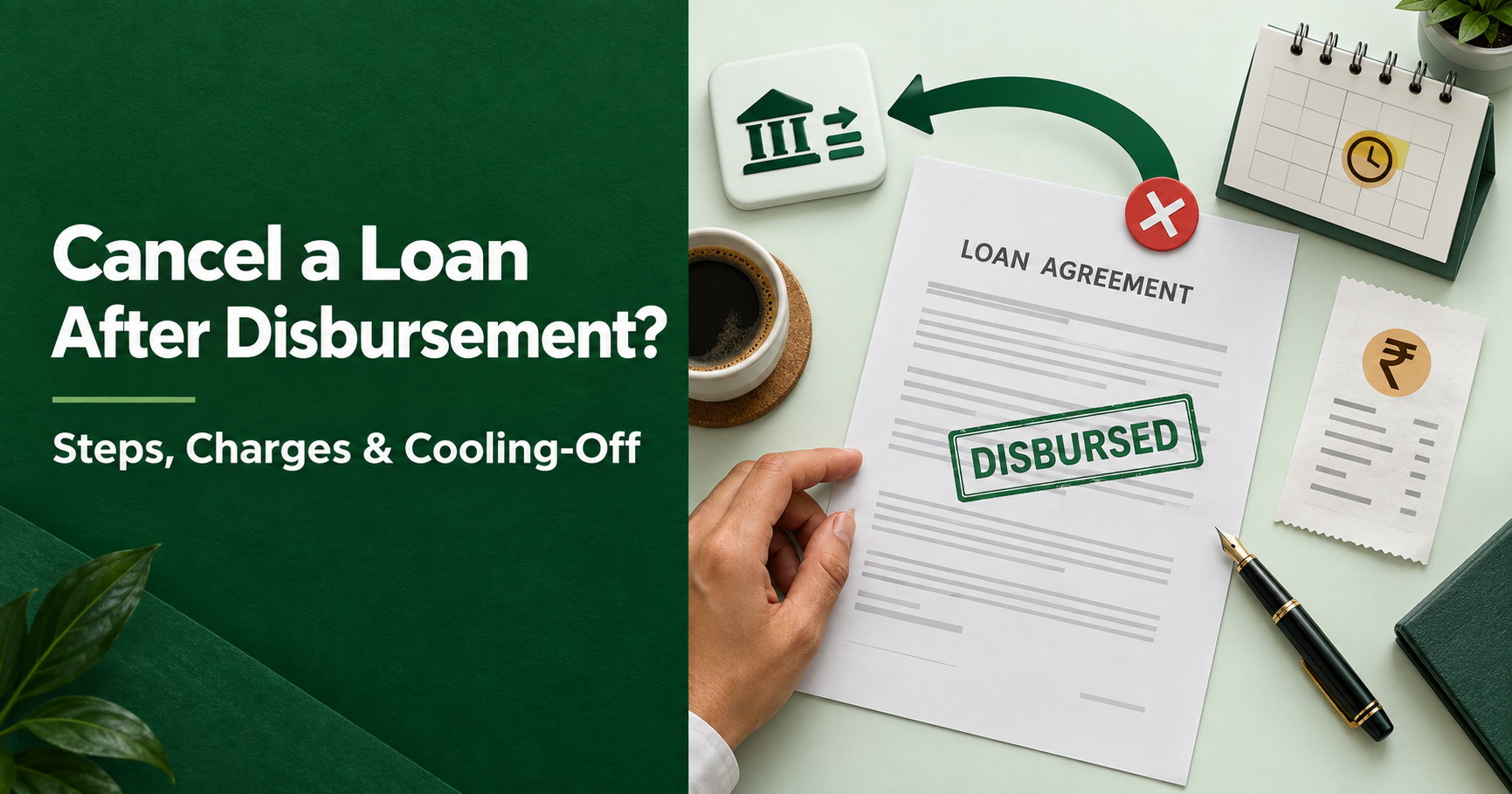
Check whether the loan was disbursed, whether a cooling-off exit still applies, and obtain written closure before assuming the account is cancelled.
Before disbursement
Cancel
Stop the application and get written confirmation
Within cooling-off
Exit
Repay principal + proportionate APR without penalty
After cooling-off
Foreclose
Request a foreclosure statement and check charges
You accepted a personal loan, the money reached your bank account—and now you no longer want it.
Can you cancel the loan?
The answer depends on whether the money has been disbursed, whether it is a digital loan and whether you are still within the lender’s cooling-off period.
- Before disbursement: Ask the lender to cancel the application immediately and obtain written confirmation.
- After a digital loan is disbursed but within the cooling-off period: You should have an option to exit by repaying the principal and proportionate Annual Percentage Rate, or APR, without a penalty. A reasonable one-time processing fee may be retained if it was disclosed upfront in the Key Facts Statement, or KFS.
- After the cooling-off period: The request will normally be treated as prepayment or foreclosure rather than cancellation. The applicable process and charges depend on the loan terms and RBI rules.
- If money was credited without your clear consent: Do not spend it or return it to an unknown caller. Contact your bank and the actual regulated lender immediately and dispute the transaction in writing.
Think of loan disbursement like a parcel that has already been delivered. Before dispatch, the order may be cancelled. After delivery, you cannot pretend it never arrived—you must follow the correct return process and collect proof that the matter is closed.
This guide explains that process step by step.
Information last verified: 14 September 2026
Cancellation, cooling-off and prepayment conditions can differ by loan type and lender. Check your KFS, sanction letter and loan agreement before paying or accepting any cancellation quote.
Quick answer: Which situation applies to you?
| Your situation | What it generally means | What to do now |
|---|---|---|
| Application submitted but not approved | No loan has been sanctioned or disbursed | Withdraw the application through the official channel |
| Approved but money not credited | Approval and disbursement are separate stages | Ask the lender to stop disbursement and confirm cancellation in writing |
| Digital loan credited within the cooling-off period | RBI’s digital-lending exit option may apply | Request an exit quote and repay within the deadline |
| Cooling-off period has ended | It is usually treated as prepayment or foreclosure | Request a foreclosure statement and check applicable charges |
| Money credited without clear consent | It may involve mis-selling, unauthorised lending or fraud | Do not spend or transfer it; verify and complain immediately |
| Cancellation requested but EMI is scheduled | The loan may still be active in the lender’s system | Keep sufficient balance until written closure is received |
First understand: Approval, cancellation and foreclosure are different
These words are often used as if they mean the same thing, but they represent different stages.
Loan application withdrawal
You ask the lender or platform to stop processing your application before final approval or disbursement.
Cancellation before disbursement
The loan may have been approved, but the lender has not released the money. You ask it to stop the transfer and close the application.
Cooling-off exit
The digital loan has already been disbursed, but you are within the limited exit period disclosed by the lender. You repay the required amount under the cooling-off conditions.
Prepayment or foreclosure
You repay the outstanding loan before the original tenure ends, usually after the cooling-off period. The lender may call this full prepayment, early closure or foreclosure.
The difference matters because the amount payable and the charges can change depending on the stage.
Can you cancel a personal loan before disbursement?
Usually, this is the simplest stage at which to stop the loan.
Contact the lender as soon as you decide not to proceed. Do not rely only on a phone conversation. Send the request through the official app, customer-care email, website or branch and keep the acknowledgement.
Ask the lender to confirm:
- Whether disbursement has already been initiated
- Whether the application can still be cancelled
- Whether any fee has been charged
- Whether any signed repayment mandate remains active
- Whether the account will show any amount due
- When you will receive written cancellation confirmation
If the status only says “approved,” first confirm what that word means. The KFS, agreement, e-sign, bank verification or repayment mandate may still be pending. Read our guide on a personal loan approved but not credited to identify the exact stage.
Cancelling the application does not necessarily remove a credit enquiry already made with your consent. It only stops the loan from proceeding, provided the lender acts before disbursement.
Can you cancel a personal loan after disbursement?
Once the money has reached your account, the bank transfer itself normally cannot simply be undone like cancelling an online order.
However, if it is a digital loan and you are still within the cooling-off period, RBI’s Digital Lending Directions provide an exit option.
The borrower must be allowed to exit by paying:
- The principal amount; and
- The proportionate APR for the period the money was held.
No penalty should be imposed for using this cooling-off exit. The lender may retain a reasonable one-time processing fee only if that possibility was disclosed upfront in the KFS.
The cooling-off period is set under the regulated lender’s board-approved loan policy, but RBI requires it to be at least one day. Do not assume that every loan offers 3, 7 or 14 days. Check the exact deadline in your KFS, agreement, app or lender policy.
You can verify the rule in the RBI Digital Lending Directions, 2025.
What is a cooling-off period in a digital loan?
A cooling-off period is a short window after disbursement during which a borrower can reconsider a digital loan and exit under the disclosed conditions.
It is designed to prevent a borrower from being trapped in a loan immediately after accepting it.
It is not:
- A period during which you can keep the money free of cost
- An automatic refund of every fee
- The same duration for every lender
- The same as the KFS validity period before accepting the offer
- A reason to ignore an EMI or repayment instruction
The clock may start from disbursement or another point defined in the applicable loan documents. Check the lender’s written terms instead of counting days based on an assumption.
Cooling-off period versus KFS validity period
These two periods are easy to confuse.
| Period | When it applies | Purpose |
|---|---|---|
| KFS validity period | Before you accept the loan offer | Gives you time to review and accept the proposed terms |
| Cooling-off period | After a digital loan is disbursed | Gives you a limited option to exit by paying the required amount |
For covered retail term loans, RBI requires the KFS to be provided before the loan contract. The KFS must disclose important costs and conditions. Learn how to review it in our Personal Loan Key Facts Statement guide.
Step-by-step: How to exit a digital loan during the cooling-off period
Step 1: Confirm that the money was actually credited
Check your complete bank statement, not only the app status or an SMS.
Note:
- Credit date and time
- Amount credited
- Bank narration
- Transaction reference or UTR
- Bank account that received the money
The cooling-off deadline can be short, so act immediately.
Step 2: Identify the actual lender
The app or platform name may differ from the bank or NBFC that provided the loan.
Find the lender’s legal name in:
- KFS
- Sanction letter
- Loan agreement
- Disbursement message
- Bank-statement narration
- App’s lender or partner section
Your repayment and cancellation request should be handled through official channels connected to the actual regulated lender.
Step 3: Read the cooling-off clause
Look for terms such as:
- Cooling-off period
- Look-up period
- Exit option
- Loan cancellation
- Early closure
- Foreclosure
Confirm the deadline, repayment method and whether a one-time processing fee will be retained.
Step 4: Send a written exit request
Use the official app, email or grievance channel. State clearly that you want to use the cooling-off exit option.
Do this even if customer care asks you to wait. A dated written request helps prove that you contacted the lender within the applicable period.
Step 5: Request an itemised exit amount
Ask for a written calculation showing:
- Principal payable
- Proportionate APR or cost
- Processing fee retained, if applicable
- GST or other amount, if applicable
- Total payable
- Payment destination
- Deadline for payment
Do not transfer money merely because an agent sends an amount on WhatsApp.
Step 6: Repay only through an official channel
For digital loans, RBI requires loan servicing and repayment to be made directly to the regulated entity’s bank account, subject to limited permitted exceptions.
Use the repayment option shown in the official app, lender website, verified bank details or written lender communication. Never send the amount to an employee’s personal account, unknown UPI ID or QR code.
Step 7: Save proof of payment
Keep:
- Payment receipt
- UTR or transaction reference
- Bank statement
- Exit quotation
- Email or ticket acknowledgement
- Screenshot of the payment status
Step 8: Obtain closure confirmation
Ask the lender to confirm that:
- The cooling-off exit was accepted
- The payment was received and mapped correctly
- The outstanding balance is zero
- No further EMI is due
- The repayment mandate will not be presented again
- The loan status will be reported correctly to credit information companies
Do not treat a payment receipt alone as proof that the loan account is closed.
Important: You may need to repay more than the amount credited
Suppose the sanctioned principal is ₹50,000, but a processing fee and applicable tax are deducted before disbursement. Only ₹48,500 reaches your bank account.
The loan principal may still be ₹50,000.
If you exit, do not assume that returning ₹48,500 will close the account. Ask for an itemised exit statement and compare it with the KFS.
This is like receiving a salary after deductions: the amount reaching the bank may be lower than the gross figure used for calculation. In a loan, the sanctioned principal, net disbursal and closure amount can be different figures.
What charges can apply during the cooling-off period?
RBI’s digital-lending rule allows the borrower to exit by paying the principal and proportionate APR without a penalty.
A regulated lender may retain a reasonable one-time processing fee if it was disclosed upfront in the KFS.
Other amounts, such as insurance-related costs, statutory charges or taxes, may depend on the nature of the charge, the applicable policy and whether the service was already provided. Ask for an itemised explanation rather than assuming everything is refundable or non-refundable.
Under RBI’s KFS rules, fees and charges not mentioned in the KFS cannot be imposed during the loan term without the borrower’s explicit consent. The KFS should also include the APR calculation and repayment schedule. See the official RBI KFS circular.
What happens after the cooling-off period ends?
After the cooling-off window, the lender will normally treat your request as full prepayment or foreclosure.
You may need to pay:
- Outstanding principal
- Interest accrued up to the closure date
- Disclosed prepayment or foreclosure charge, where permitted
- Applicable taxes on charges
- Any valid overdue amount already incurred
Ask the lender for a foreclosure statement before paying. It should specify the amount and validity date because interest may continue to accrue until payment is received.
Can the lender charge a foreclosure fee?
It depends on the loan.
Under the RBI’s Pre-payment Charges on Loans Directions, 2025, regulated entities cannot levy prepayment charges on floating-rate loans granted to individuals for non-business purposes. These directions apply to loans sanctioned or renewed on or after 1 January 2026.
In other cases, including loans not covered by that prohibition, charges may follow the lender’s approved policy. Any applicable prepayment charge must be disclosed in the sanction letter and loan agreement and, where a KFS is required, in the KFS. An undisclosed prepayment charge cannot be imposed under these directions.
Read the RBI Pre-payment Charges on Loans Directions, 2025 for the complete scope.
Do not assume that every personal loan is floating-rate. Check the “interest-rate type” in your KFS or agreement.
Can you cancel the loan if you have already used some of the money?
Using part of the loan does not automatically remove the cooling-off option, but you must still be able to repay the full amount required by the lender within the applicable deadline.
For example, if ₹40,000 was credited and you spent ₹10,000, you cannot close the loan merely by returning the remaining ₹30,000. You must arrange the complete exit amount.
If you cannot repay it within the cooling-off period, the loan may continue under its normal schedule. Contact the lender before the deadline and ask about the available options. Do not borrow from another costly app only to cancel the first loan without comparing the total cost.
Will cancelling the loan remove the credit enquiry?
Not necessarily.
A credit enquiry may already have been recorded when the lender assessed your application with your consent. Withdrawing or closing the loan does not normally erase a genuine enquiry.
If the loan was disbursed, it may also be reported as a loan account to credit information companies. After successful exit or foreclosure, check that the account is eventually reported with the correct closed status and zero outstanding balance.
Do not raise a dispute simply because a genuine enquiry remains visible. Raise one when the information is inaccurate, unauthorised or not updated after a reasonable reporting period and lender follow-up.
Should you cancel the auto-debit mandate immediately?
Do not cancel the mandate before the lender confirms the exit amount has been paid and the loan is closed.
If the loan remains active, prematurely stopping the mandate could cause:
- A failed EMI
- Bounce or penal charges under the disclosed terms
- Collection communication
- Incorrect overdue reporting
After receiving closure confirmation, ask the lender whether the mandate will be cancelled automatically. Check your bank’s mandate list as well.
If an EMI is deducted again after closure, follow our guide on an EMI deducted twice or after loan closure.
What if the loan amount was credited without your clear consent?
Treat this as a different and potentially serious situation.
You may have entered details only to check eligibility, clicked a misleading button, shared an OTP without understanding its purpose, or dealt with a suspicious app that transferred a small amount and demanded much more.
Take these steps:
- Do not spend the money. Keep the amount untouched while the matter is investigated.
- Do not return it to a caller’s UPI ID or QR code. You could send money to a fraudster while the alleged loan remains open.
- Check your bank statement. Record the sender name, amount, date and reference.
- Ask for the documents. Request the KFS, agreement, consent record, sanction details and actual lender’s legal name.
- Contact the regulated lender directly. Use contact details from its official website, not those provided by an unknown caller.
- Inform your bank. Report an unexpected credit and ask it to record the complaint.
- Preserve evidence. Save app screenshots, permissions, messages, call records and threats.
- Report suspected cyber fraud promptly. Financial cyber-fraud complaints can be reported through the National Cyber Crime Reporting Portal or helpline 1930.
Do not assume that an unexplained credit is free money. Equally, do not accept an inflated repayment demand without verified documents and an official account statement.
If an app threatens to contact your family, misuse your photos or publish your data, record the evidence and use the appropriate lender, police and cybercrime complaint channels.
Copy-and-send loan cancellation request
You can adapt this message:
Subject: Request to exit/cancel personal loan – Loan account [number]
I request cancellation/exit of my personal loan associated with loan account/application number [number]. The amount of ₹[amount] was credited on [date and time]. I am submitting this request on [date], within the cooling-off period stated in my KFS/loan agreement, if applicable.
Please provide the itemised amount required to close the loan, including principal, proportionate APR, processing fee retained and any other applicable amount. Please also confirm the official repayment channel and payment deadline.
After payment, please issue written confirmation of zero outstanding balance, loan closure and the status of the repayment mandate. Please ensure that the account is reported accurately to the credit information companies.
Name: [name]
Registered mobile number: [masked number]
Application/loan account number: [number]
Do not include an OTP, UPI PIN, ATM PIN, password or complete card details.
If the lender refuses or does not respond
Follow a documented escalation path.
1. Contact customer support
Raise a ticket through the official app, website or email. Save the complaint number and date.
2. Escalate to the grievance officer
The grievance officer’s details should be available in the KFS, on the lender’s website and, for digital loans, in the app or platform.
Send:
- Loan account and application reference
- Disbursement date and amount
- KFS and agreement
- Cooling-off clause
- First cancellation request
- Exit quote, if received
- Payment proof
- Screenshots and earlier complaint numbers
- Exact resolution you want
3. Approach the RBI Ombudsman when eligible
Under the Reserve Bank–Integrated Ombudsman Scheme, 2026, first complain to the regulated entity.
You may approach the RBI Ombudsman if you receive an unsatisfactory response or do not receive a reply within 30 days, subject to the Scheme’s eligibility and maintainability requirements.
Complaints can be filed free of charge through the RBI Complaint Management System. The current scheme also allows complaints by email to `crpc@rbi.org.in` or by physical submission to RBI’s Centralised Receipt and Processing Centre.
The Ombudsman route addresses deficiencies in service by covered regulated entities. It does not guarantee that every commercial decision or contractual dispute will be decided in the borrower’s favour.
If you applied through ZapCash
ZapCash’s published Cancellation Policy says an application may be cancelled before final approval or disbursal by submitting a request through the registered account or customer support.
If the loan has already been disbursed, do not simply transfer the money back. Check the KFS and agreement for:
- Actual lending partner
- Cooling-off period
- Exit or foreclosure method
- Itemised payable amount
- Official repayment account
- Grievance officer details
You can contact ZapCash support and, where necessary, the regulated lending partner shown in your loan documents. ZapCash’s lending-partner page and grievance policy provide further information.
Real-world example: Cancelling quickly can change the process
Suppose Arjun accepts a ₹60,000 digital personal loan on Monday afternoon. The money reaches his account the same day. On Tuesday morning, his employer confirms that a delayed salary reimbursement has arrived, so he no longer needs the loan.
Arjun does not spend the ₹60,000. He opens the KFS, checks the cooling-off clause and sends a written exit request immediately. He asks for an itemised amount instead of returning the money to a UPI ID given over the phone.
The lender confirms the official repayment route. Arjun pays the principal and applicable proportionate cost within the deadline, saves the receipt and obtains written closure confirmation.
If he had waited until after the cooling-off period, the request might instead have been handled as foreclosure under the loan agreement.
The difference is similar to returning a product within its defined return window. Missing the window does not always make return impossible, but a different process and cost may apply.
Personal loan cancellation checklist
Before considering the matter closed, confirm:
- ☐ I checked whether the loan was actually disbursed.
- ☐ I found the actual bank or NBFC named in the KFS.
- ☐ I checked the exact cooling-off deadline.
- ☐ I sent a written exit request.
- ☐ I received an itemised closure amount.
- ☐ I paid only through an official channel.
- ☐ I saved the transaction reference and receipt.
- ☐ I received confirmation of zero outstanding balance.
- ☐ I confirmed the repayment mandate status.
- ☐ I checked that no EMI remains scheduled.
- ☐ I will verify the loan’s credit-report status later.
- ☐ I kept all documents and complaint numbers.
Frequently asked questions
Can I cancel a personal loan immediately after disbursement?
If it is a digital loan and you are within the lender’s cooling-off period, you should have an option to exit by paying the principal and proportionate APR without a penalty. Check the KFS for the exact deadline and any disclosed one-time processing fee.
Is there a three-day cancellation period for every personal loan?
No. There is no universal three-day period for every personal loan. Under RBI’s Digital Lending Directions, the lender sets the cooling-off period under its board-approved policy, subject to a minimum of one day.
Can I cancel a loan after approval but before disbursement?
Ask the lender to stop the process immediately. Cancellation is generally simpler before funds are released, but you should obtain written confirmation that no amount was disbursed and no repayment is due.
Is the processing fee refunded if I cancel the loan?
Not always. During a digital-loan cooling-off exit, the lender may retain a reasonable one-time processing fee if it was disclosed upfront in the KFS. Treatment of other charges depends on the applicable terms and service.
Do I repay only the amount that reached my bank account?
Not necessarily. If a fee was deducted upfront, the net amount credited may be lower than the loan principal. Request an itemised exit statement and repay the confirmed amount through the official channel.
Can the lender charge a foreclosure penalty during the cooling-off period?
RBI’s digital-lending rule provides for exit during the cooling-off period without a penalty, after payment of principal and proportionate APR. A disclosed reasonable one-time processing fee may still be retained.
What if the cooling-off period has expired?
The lender will usually treat the request as prepayment or foreclosure. Ask for a foreclosure statement and compare every charge with the KFS, sanction letter, agreement and applicable RBI rules.
Will loan cancellation affect my credit score?
A legitimate credit enquiry may remain. If the loan was disbursed, the account may also be reported and later updated as closed. The effect depends on how the lender reports the account and the rest of your credit profile.
Should I cancel the e-mandate before the loan is closed?
No. First complete the exit or foreclosure process and obtain confirmation that no payment remains due. Cancelling the mandate too early could cause a failed EMI if the loan is still active.
What if the lender accepts payment but does not close the loan?
Send the payment proof and request a corrected loan statement and closure confirmation. Escalate to the lender’s grievance officer if unresolved, and use the RBI Ombudsman route when eligible.
What should I do if a loan was credited without consent?
Do not spend it or transfer it to an unknown person. Record the credit, contact your bank and the actual regulated lender, request the agreement and consent evidence, and report suspected fraud through official cybercrime channels.
Can a loan agent collect the cancellation amount?
Do not pay an agent’s personal account, wallet, QR code or UPI ID. Use only the repayment channel confirmed by the regulated lender through an official source.
Can I delete the loan app after requesting cancellation?
Keep the app and records until you receive closure confirmation and download your KFS, agreement, statement and receipts. Deleting the app does not cancel the loan or remove the repayment obligation.
Final takeaway
You may be able to stop a personal loan before disbursement by contacting the lender immediately.
After a digital loan has been disbursed, check the cooling-off period without delay. During that window, RBI rules provide an exit option on payment of the principal and proportionate APR without a penalty. A reasonable one-time processing fee may be retained if disclosed upfront in the KFS.
After the cooling-off period, the process generally becomes prepayment or foreclosure, and the applicable charges depend on the loan and governing rules.
Whatever stage you are at:
- Do not spend the money if you plan to exit.
- Do not send repayment to an unknown person or QR code.
- Ask for an itemised payable amount.
- Pay through the regulated lender’s official channel.
- Obtain zero-balance and closure confirmation.
- Confirm that the auto-debit mandate and credit reporting are updated correctly.
If the money was credited without clear consent, treat it as a dispute rather than an ordinary cancellation. Keep the funds untouched, preserve evidence and report suspected fraud promptly.
Official sources
- RBI: Digital Lending Directions, 2025
- RBI: Key Facts Statement for Loans and Advances
- RBI: Pre-payment Charges on Loans Directions, 2025
- RBI: Integrated Ombudsman Scheme, 2026 FAQs
- RBI Complaint Management System
- National Cyber Crime Reporting Portal
This article is for general information and does not constitute legal or financial advice. Loan cancellation, cooling-off, refund, prepayment and foreclosure conditions can vary. Follow your KFS, loan agreement and the instructions of the actual regulated lender.